

Why Reputation Management for Doctors Matters in 2025
In today’s digital-first healthcare landscape, a doctor’s online reputation is as important as clinical expertise. In fact, 77% of patients read online reviews before choosing a healthcare provider (Pew Research, 2024). Positive doctor reviews build credibility, while a lack of reputation strategy—or worse, negative reviews—can drive potential patients to competitors.
This makes reputation management for doctors essential for attracting new patients, retaining existing ones, and building long-term trust.
👉 Related Reads:
- Healthcare Marketing for Doctors and Medical Practices
- SEO for Doctors: How to Rank Higher and Attract More Patients
- Healthcare Website Design: Proven Strategies to Attract & Convert More Patients
The Rising Importance of Online Reputation in Healthcare
Patients now rely on digital platforms as their primary source of trust-building information:
- 84% of patients trust online reviews as much as personal recommendations (NRC Health, 2024).
- Listings on sites like Google Business Profile, Healthgrades, and Zocdoc directly influence appointment bookings.
- Doctors with an average rating of 4.5 stars or higher see a significant boost in patient inquiries.
Example: A family medicine practice in Florida had only 12 reviews with a 3.2-star rating. After implementing a structured review and response strategy, they reached 4.6 stars with 130+ reviews in under a year—leading to a 45% increase in new patient calls.
How Reviews Influence Patient Decisions
Patients don’t just read reviews; they act on them. Consider these trends:
- 94% of patients say online reviews impact their decision to choose a doctor.
- The top 3 review platforms patients use are Google (71%), Healthgrades (48%), and Yelp (22%).
- Negative reviews without responses decrease trust, while responding professionally to feedback can improve perception by 70%.
This means medical practice reviews are not just feedback—they’re part of your marketing funnel.
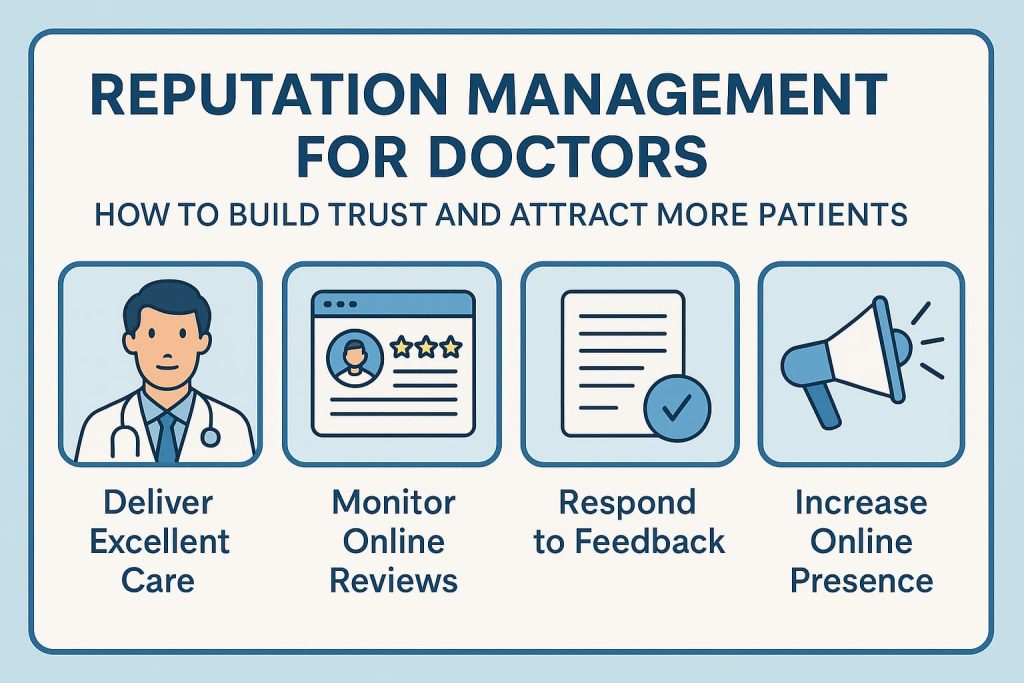
Strategies for Effective Reputation Management for Doctors
1. Request Reviews Proactively
- Ask satisfied patients for feedback after visits.
- Use automated email or SMS reminders with a direct link to your Google profile.
- Train staff to ask patients at checkout: “Your feedback helps others—would you mind leaving us a quick review?”
2. Monitor Reviews Consistently
- Set up alerts via Google or software like Birdeye or Podium.
- Track mentions on Google, Yelp, Healthgrades, Vitals, and Facebook.
- Assign a team member or marketing partner to oversee ongoing monitoring.
3. Respond to Reviews Professionally
- Thank patients for positive reviews.
- Address concerns in negative reviews politely and invite patients to continue the conversation offline.
- Never disclose personal health information (HIPAA compliance is crucial).
4. Leverage Google Business Profile
- Optimize your profile with services, hours, and images.
- Actively manage Q&A and updates to boost local SEO.
- Encourage patients to leave reviews directly on Google for higher visibility.
5. Utilize Healthcare Directories
- Ensure consistent NAP (Name, Address, Phone) across Healthgrades, Zocdoc, WebMD, and Vitals.
- Add photos, credentials, and specialties to build patient confidence.
Common Mistakes Practices Make in Reputation Management
- Ignoring negative reviews – Silence signals neglect.
- Buying fake reviews – These can be flagged and damage credibility.
- Overreacting publicly – Responding emotionally can harm your reputation more than the review itself.
- Inconsistent branding across platforms – Patients expect consistency in tone, service listings, and visuals.
Case Study: How Reputation Management Attracted New Patients
The Challenge: A cardiology clinic in Chicago struggled with a 3.0-star average across 40 reviews, hurting patient acquisition.
The Strategy:
- Implemented an automated patient feedback strategy via email.
- Added review links on appointment reminders.
- Developed a response template for staff to handle reviews within 48 hours.
- Optimized their Google Business Profile with service categories and photos.
The Result (6 months):
- Review volume grew to 150+, with an average of 4.7 stars.
- Website traffic increased by 62%, partly due to improved local SEO.
- New patient appointments rose by 38%.
Future-Proofing Reputation Management in Healthcare
In 2025 and beyond, online reputation management in healthcare will evolve with AI-driven review analysis, video testimonials, and integration with patient engagement platforms. Practices that stay proactive will continue to attract and retain patients in competitive markets.
FAQs: Reputation Management for Doctors
Q1. Why is reputation management important for doctors?
It directly impacts patient trust, appointment bookings, and overall practice growth.
Q2. Which platforms matter most for doctor reviews?
Google, Healthgrades, Yelp, and Zocdoc are top review platforms for patients.
Q3. How can doctors handle negative reviews?
Respond politely, remain HIPAA-compliant, and resolve the issue offline when possible.
Q4. Can a practice recover from a poor online reputation?
Yes. With consistent review requests and proactive responses, practices can rebuild trust within months.
Q5. Does CareNova help with online reputation management?
Absolutely. CareNova provides tailored strategies for requesting, monitoring, and improving medical practice reviews.
Conclusion: Take Control of Your Reputation
Your online reputation is your digital word-of-mouth. Patients are reading reviews before they ever call your office, and the doctors who invest in reputation management for doctors see higher trust, stronger patient engagement, and steady growth.
At CareNova, we specialize in online reputation management for healthcare, helping doctors like you build credibility, manage patient feedback, and attract more patients.